How high is your electric bill?
And some different HOME figures.

Correction: Last week I wrote that the City Auditor has eight employees. In fact, those are just the leaders listed on the department website. The office actually has 29 full-time employees.
Fraud at Austin Energy
The big news today is a City Auditor report about a former Austin Energy employee who defrauded the utility of nearly $1 million:
Between fiscal years 2018 and 2023, we found that Ybarra paid fictitious vendors around $980,000 using his purchasing card. During this period, he paid at least 30 vendors through his purchasing card. Of these 30 vendors, only eight appear to be registered City vendors.
Good stuff. You can read the whole report here.
As you might imagine, some view this as evidence that the city needs a third-party audit. But another conclusion would be that the city should simply invest more in its in-house auditing team.
Rich people problems
For its house-hunting series, "The Hunt," the New York Times interviewed a couple that recently relocated from a 4-bedroom house in Barton Springs to Palm Springs, Calif:
They thought about moving to Tucson, Ariz., or back to California. “We were not liking either climate in Texas — political or weather,” Mr. Barenholtz said. “We were spending more time at our lake house in Northern Michigan in the spring and fall along with the summer, and yet our electric bill in Austin was $2,000 a month in summer, even when we weren’t there.”
A reader alerted me to the story and asked: Is this hyperbolic, or does this really happen to some people? Did they leave their AC on at 65 and have a big pool that they chilled ice cold while they were away?
The reader, who lives in a 1,700 square foot home in Central Austin with a partner and two kids, only paid $97 for electricity in July and $215 for the total utility bill.
The number was stunning to me too. The entire bill for our three-person household was consistently under $200, even in the hellish summer of 2023. Granted our house was barely 1,000 sq ft, we didn't water our grass and my wife's preferred indoor temperature is well above average.
But then I talked to a friend who has a family of four in an enormous house in West Austin with a pool. He told me his total utility bill is close to two grand. So if I had to guess, the guy the NYT interviewed was conflating total utility bill with electric bill, but it's still very high.
How much do you pay for electricity? I'd be curious to hear.
Central Texas's water challenges
KUT reports on efforts by Williamson County leaders to confront the growing risk of water shortages:
A 2022 report revealed that Georgetown must find a new water source by 2030 in order to avoid supply shortages. The city is currently working to negotiate a long-term water supply agreement with another local water utility, EPCOR, to bring in groundwater from the Carrizo-Wilcox Aquifer in Robertson County — just north of the Bryan-College Station area.
A recent report from Texas 2036, a nonprofit, public policy organization, also suggested the state will face a long-term water deficit if it fails to develop new supplies and gets hit by another multi-year drought — costing the economy hundreds of billions of dollars.
Yep. This could very well be Central Texas's (and perhaps the world's!) defining challenge in the coming years. The city of Austin has a certain degree of water security through 2050 thanks to a deal City Council approved with the Lower Colorado River Authority in 1999, but the climate trends should trouble everyone. In recent years some developers have abandoned planned residential projects outside of the city because they can't get their projects hooked up to an affordable water source.
Some different HOME figures
The American Enterprise Institute, a right-leaning think tank, has published its own mini-analysis of the HOME initiative. Unlike the city's own recently-released report, which focused on the number of building permits issued, AEI's report focuses on certificates of occupancy, which more closely reflects the number of new homes that actually built:
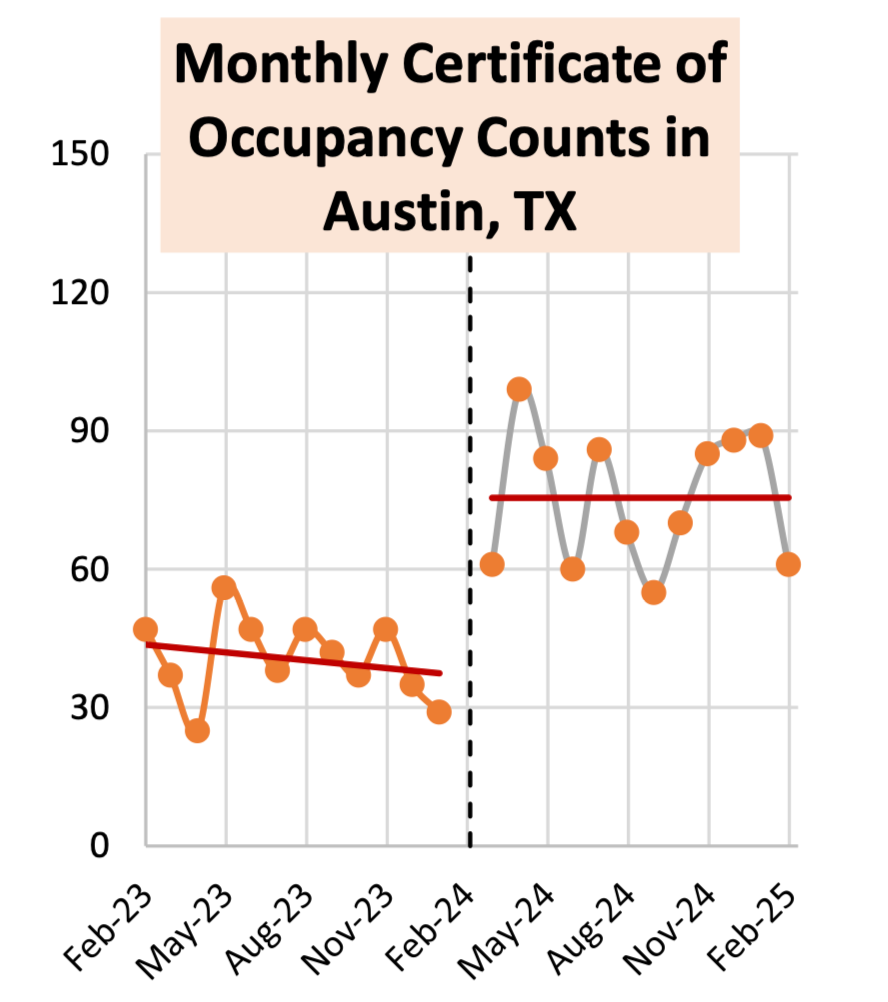
According to AEI's analysis, in the year preceding the enactment of HOME, there were 487 units built in the single-family zones that were affected by HOME (SF-1, SF-2, SF-3). In the year following HOME's passage, there were 906 new units built in those zones, an 86% increase.
That's an encouraging vignette, especially considering that there aren't any other obvious reasons there would have been an uptick in construction during that time. Just imagine how many units could be delivered if the city's development review system weren't such a disaster!
Please tell your friends to get their OWN subscription to the Austin Politics Newsletter! And please contact me if you're interested in a discounted group subscription for your company or organization.