What's wrong with the bus?
Why is ridership down?

The latest Cap Metro ridership figures are out. Not looking good. The new payment system and high gas prices should have helped but they haven't. Ridership in May was down from the previous year, the 12th consecutive month of year-over-year declines.
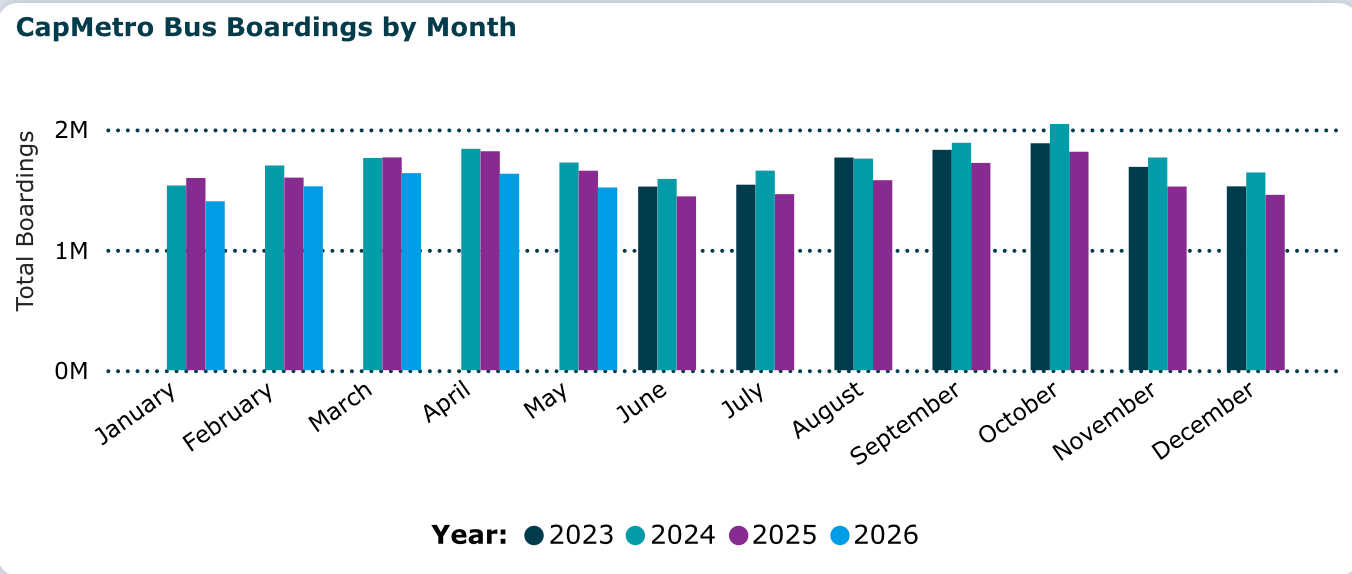
In a statement, a Cap Metro spokesperson said the agency is "monitoring ridership and looking at all potential factors that may be contributing to the dip in May."
On my last two trips back to Austin (March & May) I rode the bus 13 times. I have good news and bad news to share.
Paying
The good news is Tap2Pay. What a massive improvement! Anybody can now get on a bus and simply pay with their credit card or mobile wallet, just like they do for everything else in the world. The old app was such a disaster that I used to take the extraordinary measure of actually paying in change, something that, for better or worse, cannot be reasonably expected of Americans under 80 these days.
The payment issues that Cap Metro has had in the past have been somewhat ironic because Cap Metro is practically free. You're not going to find a fare for less than $1.25 at any other major transit agency in the country.
Reliability
I didn't track my waits, but I do know that on a number of occasions the bus came very late. This is not necessarily Cap Metro's fault. Unless you provide buses with dedicated right-of-way, they'll get stuck in traffic just like any other car.
Cap Metro buses' on-time performance of 78% seems to align with bus services in other cities. And as is the case for most rail services around the country, Cap Metro's single rail line is on time more than 90% of the time.
What's troubling is that the on-time performance has been particularly bad over the past year for Cap Metro's most popular route. The 801 MetroRapid, which runs along S. Congress, Guadalupe & N. Lamar has been on time less than 70% of the time for 11 straight months — it got as low as 56% in October and was 68% in May.
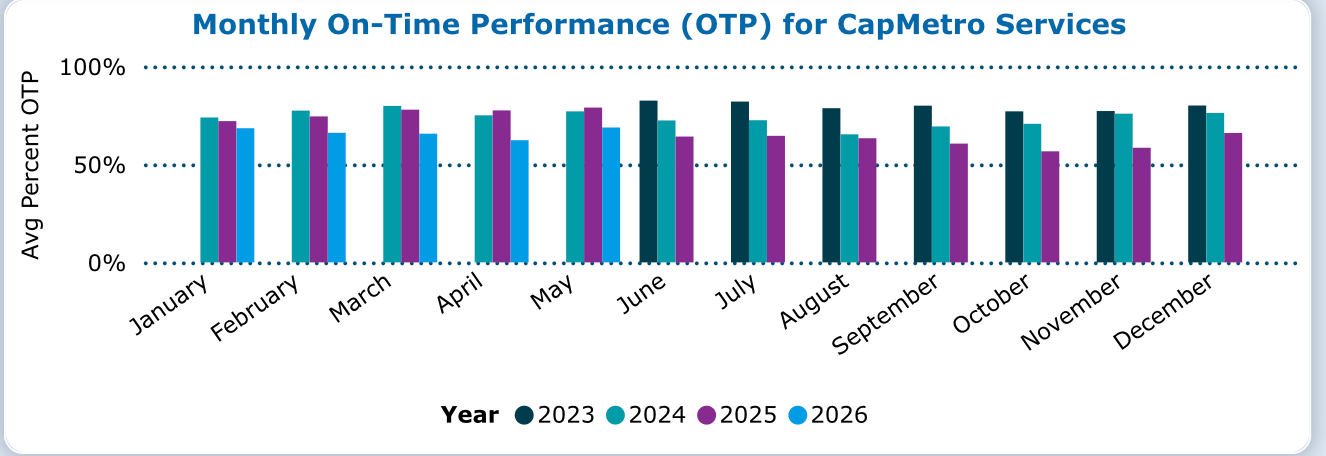
Things are looking much better for the 803 MetroRapid, another popular route that serves S. Lamar, Guad and Burnet. Its OTP was 84% in May.
I don't know exactly why the 801 has been tardy so frequently, but I would guess it has something to do with route-specific disruptions due to construction. This is just the shitty bargain you have to accept with buses that operate in general purpose travel lanes.
Experience
There's no way to sugarcoat it: riding the bus in Austin can be a pretty gritty experience. The rides can be extremely bumpy and loud. Other riders are often blasting whatever nonsense they're listening to or watching on their phones for everyone else to hear.
Most importantly, the bus is the epicenter of the city's homelessness, mental health and addiction crises. I don't have data to indicate that the problem is worse than it was a few years ago, but it certainly has felt worse for me.
On my last trip to Austin, I got on the 20 bus at the airport and a couple stops later a couple of strung-out looking patrons got on the bus with an unleashed dog. The bus operator told them the dog wasn't welcome; the two people screamed at her and at each other for about a minute and eventually left. The operator did exactly what she was supposed to do and the incident was resolved relatively quickly, but it was still extremely unpleasant.
Cap Metro has made a point of investing in additional security, both in the form of actual transit police and "public safety ambassadors" who are supposed to provide some reassuring visibility as well as to connect vulnerable users with other services. I hope these measures are making employees and customers safer, but there is only so much they can do to make public transit attractive to those with access to other transportation options. Most homeless people on the bus aren't doing anything wrong, but their presence is still a turnoff to most non-homeless people. I'm not saying it's right, but we all know it's the truth.
Actually, to be precise, the issue is not so much the presence of homeless people, but the share of riders who are homeless. There are homeless people at the Central Library, but the service and space are compelling enough to attract people from across Austin's socioeconomic spectrum. The same is true of public transit systems in most other major western cities. That would also be the case with Austin light rail, if and when that becomes a reality.
Please tell your friends to get their OWN subscription to the Austin Politics Newsletter! And if you found this article particularly valuable, you can show your appreciation by buying me a cup of coffee to fuel further investigation and analysis of city politics.