How do you define a billboard?
& do we need more ads in public spaces?

There is big news about Project Connect. I will get to that tomorrow!
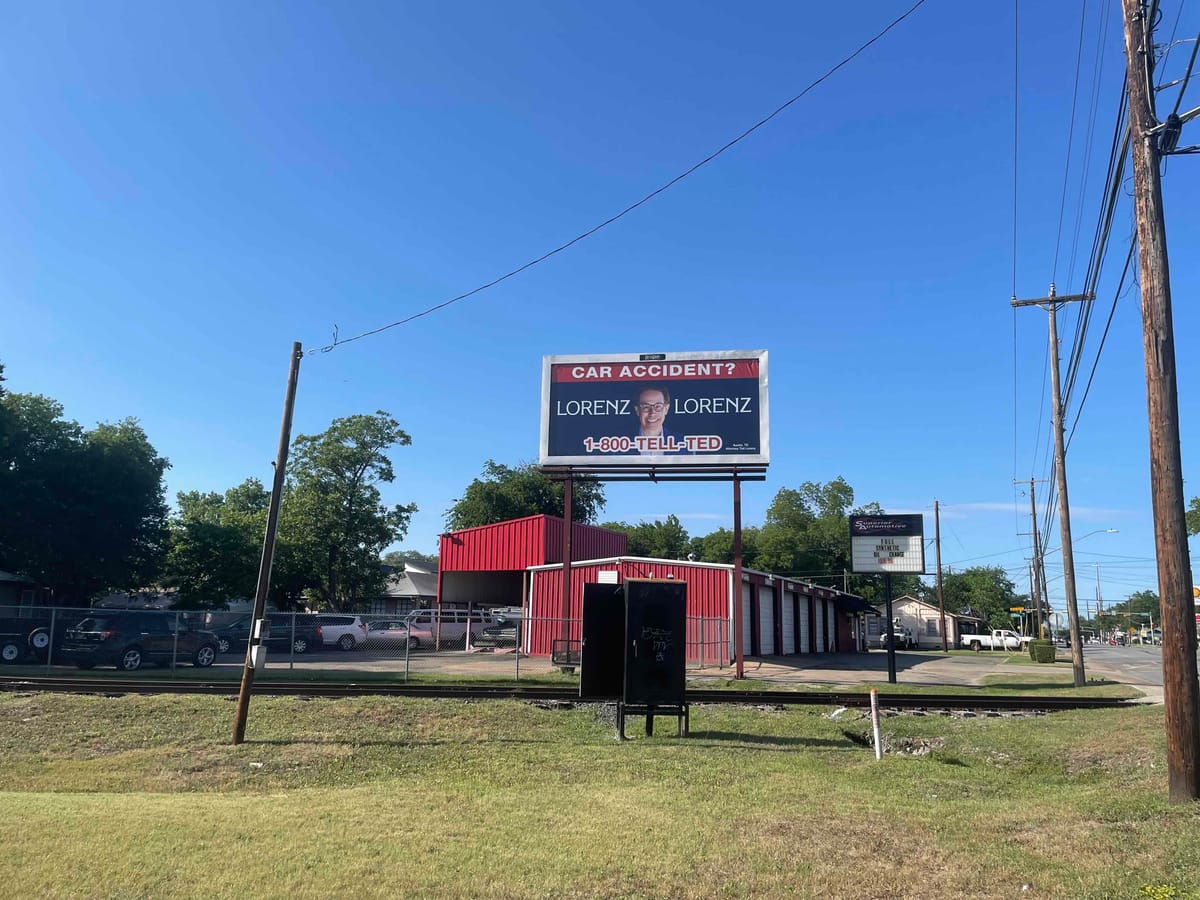
In 1984, the city of Austin banned "off-premise advertising," the fancy term for billboards.
And yet, nearly all of the roughly 600 billboards that were erected before the prohibition remain to this day. Almost all of them are owned by a couple of large companies, notably Reagan Outdoor Advertising.
The only way the city can take them down is to buy the owner of the billboard out of what is apparently a profitable business. As far as I can tell, the city has never tried to do this.
Even in instances when a billboard is condemned via eminent domain because it stands in the way of a road project or utility line, the city doesn't compensate the company; it simply allows it to move the sign to a new location. It has strict rules about where the new location can be. Most notably, it can't be within 500 feet of a home – single-family or multifamily – or on a "scenic roadway" (Mopac).
This week City Council is considering the first proposed changes to the city's billboard ordinance. Both changes were authored by city staff but prompted by resolutions that City Council passed in late 2024, asking staff to add some flexibility on the issue. But some members of the Planning Commission are clearly troubled.
Let's look at the two distinct issues.
Moving pains
Staff has proposed lifting the restrictions on where signs may be relocated to if the billboard in question must be moved due to "transportation improvements along core transit corridors and future core transit corridors."
(Core Transit Corridors are something that is similar but not the exact same as Imagine Austin Corridors – either one can be invoked whenever it serves a staff goal)
So it looks like the city is anticipating having to move some billboards as part of Project Connect, the I-35 expansion or maybe even those never-ending corridor projects, and it realizes that finding locations that will be suitable to the companies will be challenging with the current rules in place. So it needs to either change the rules or be prepared to cough up some serious coin to the billboard barons.
How much coin? Unclear. Staff wasn't able to provide an answer. But there's no amount of money the city should part with easily in this moment of fiscal scarcity.
A number of commissioners were clearly interested in the city at least considering to pay to get rid of the signs entirely, but they all also were aware that the city is not in a prime position to throw money around.
"I think there is an element of encouraging the sign owners to take a different option that some of us would appreciate," said Commissioner Brian Bedrosian.
The funny thing is that a decade ago Reagan and other billboard owners unsuccessfully pushed to allow them to digitize their existing billboards. They offered a deal: for every billboard that they digitized, they would take another one down. (In one of the stranger aspects of the CodeNEXT saga, Reagan et al funded a NIMBY campaign to block the code rewrite)
The commission voted to postpone further deliberation on the matter.
Digital signs: a service or a sellout?
Another proposed ordinance change would allow the installation of digital signs in the public right-of-way.
The ordinance change is proposed to enable a contract that city staff has already negotiated with a vendor, IKE Smart City, a company based in Columbus, Ohio that operates "digital kiosks" in cities across the country that look like this:
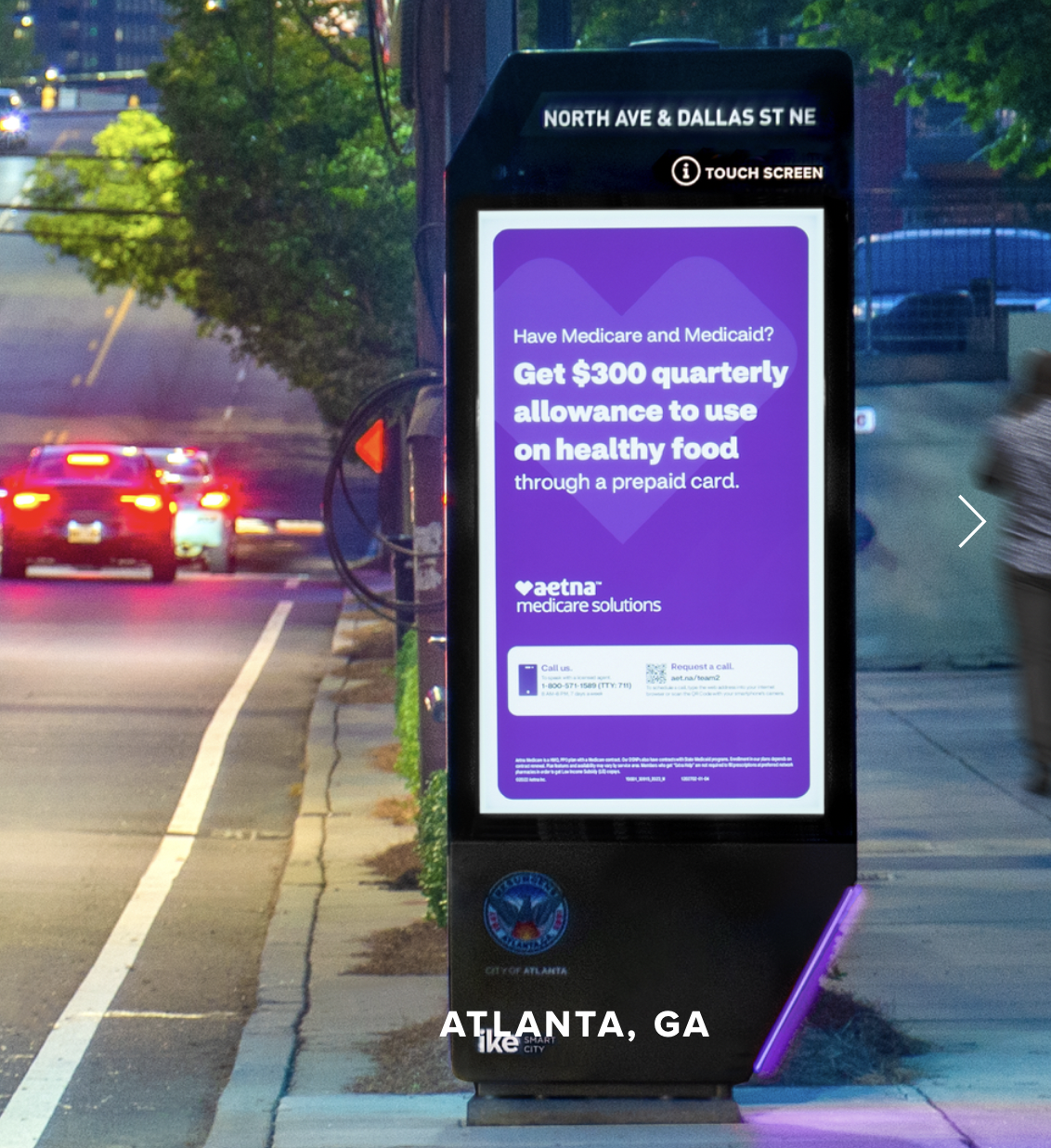
In theory, these are not just billboards. They also serve a "wayfinding" function.
Google Maps, but germier? Jibran Shermohammed, IKE vice president of development, described the kiosks t0 commissioners:
"Imagine an eight-foot tall iPad. You walk up to the screen, you tap the screen, it unlocks and opens a series of applications that helps you figure out where to eat and drink, where to shop, where to play, where to stay, generally how to navigate the city."
It's a familiar concept. So familiar because nearly all of us already carries it around in our pocket.
IKE argues that its signs offer more useful wayfinding than Google Maps. It allows a more localized search that cities can customize to highlight local cultural landmarks, walking tours. They claim their kiosks will help you better figure out how to access transit and micromobility (bikes/scooters) to get to destinations nearby. They also say it offers a valuable resource to homeless people to look up social services. I've never tried one, so I can't judge.
Whether they're useful may be up for debate, but nobody can deny the usefulness of the money the signs would generate for the city.
The city's share of the ad revenue would eventually amount to a projected $6.3 million per year at full buildout of 100 signs, said Shermohammed. He added that a provision in the contract guarantees the city a minimum payment of $2 million a year regardless of how much the company makes off the kiosks.
The 100 signs would presumably be concentrated downtown and perhaps parts of surrounding neighborhoods with heavy foot traffic.
I requested a copy of the proposed contract but was told I need to file a public information request. Cap Metro is separately considering putting advertising on its own assets (bike share stations, bus stops), which the proposed code change also aims to enable.
A rep for the Economic Development Department also stressed that the kiosks would display public service announcements and other free promotions of city-run events and the like.
Most troubled by the prospect of digital signs downtown was Planning Commission Chair Alice Woods. A devout urbanist/YIMBY, Woods is not typically one to resist change or deplore threats to neighborhood character, but she clearly believes that there is already enough advertising in our lives.
She grilled Shermohammed on the types of ads the kiosks would display. When he said that it would not display "obscene" or "bigoted" content, she replied, "So, firearms, sports betting, cosmetic surgery, predatory financial products, political ads, all fair game?"
No political ads or firearms, he said.
Later, Woods pushed the commission to postpone a recommendation on the code change. She liked the idea of bolstering urban wayfinding and IKE "seems very reputable," she said.
"But," she added, "I'm extremely concerned that the off-premise advertising portion of this code change does really open the door to digital advertising in a way that it feels like we may never be able to come back from. It is very nice not to be inundated with digital advertising in our public spaces, and I fear it's the kind of thing we won't fully appreciate before it's too late."
Commissioner Felicity Maxwell, who usually sides with Woods on development issues, said she understood her colleagues' concerns, but said she felt the proposed contract with IKE had been carefully vetted and that it was "specifically designed in a way to encourage digital wayfinding and support our transit agency, which I think is a great plus."
Hmm. That's a tough one. I'm glad I don't have to take the vote.
Almost everyone draws a line somewhere. There would be something intuitively wrong about selling the naming rights of the public library to DraftKings. But now that I think of it, that sounds exactly like something that may be coming to the National Archives. They will pay in TrumpCoin.
But perhaps in practice these signs will be somewhat useful and the ads they display are quite quaint compared to the profit-driven algorithms pounding our brains the rest of the day. And the city could certainly use the money ....
A motion by Woods to postpone a recommendation drew a majority of those present (5-3) but failed to get the 6 votes needed for a majority of the entire body. A motion to recommend the ordinance change deadlocked, 4-4, so it goes to Council this Thursday without a recommendation.
I'll be very curious to see if anyone on Council pushes back.
Please tell your friends to get their OWN subscription to the Austin Politics Newsletter! And if you found this article particularly valuable, you can show your appreciation by buying me a cup of coffee to fuel further investigation and analysis of city politics.