How much does it cost to "Save Muny?"
It's not free, you know?

Please enjoy the complimentary article below. And please consider signing up for the newsletter to get regular updates and analysis on City Hall affairs.
Mayor Kirk Watson triumphantly announced today that Lions Municipal Golf Course has been saved. This is the moment where every self-described fiscal conservative cheers for government waste.

The Austin Metric is a new policy-focused newsletter by Julio Gonzalez Altamirano. Each month, Julio will analyze the most meaningful local-government policy story in Austin. No AI slop or hot takes. Just wonky coverage of the decisions that matter. The Austin Metric newsletter is free and always will be. Subscribe today.
The financials of the deal remain very vague. According to Watson, a game-changer is a group of anonymous donors:
A wonderfully generous set of donors—people who believe strongly in Muny being preserved as important greenspace and as an 18-hole golf course—has stepped up to contribute a very large amount of money to the University to support UT’s students and campus.
The donation is big and it's an important part of a potential agreement that opens the door to UT conveying Muny to the City of Austin and the WAYA campus to WAYA.
I’m beyond grateful for these donors who are long-time Austinites and who want to remain anonymous. They believe in Austin. Austin owes them great thanks. I’m also grateful for UT Austin and its current leadership for their collaboration through this process.
From what Watson is describing, it appears the city is not going to have to spend money outright to acquire Muny, so that's good. (In general, the city golf courses are self-sustaining, their operations funded entirely by green fees)
What remains unclear is whether there will be an attempt to get taxpayers to subsidize Muny through the Save Historic Muny District that Watson created through a 2019 state law he got passed. The legislation empowered the district — bounded by N. Lamar to the east, Lady Bird Lake to the south and west and 35th St to the north — to impose a utility surcharge if approved by district voters. Sure, it's democratic in theory but in practice it will likely be a tiny group of Tarrytown homeowners turning out to raise taxes for a place and cause that many apartment-dwellers on N. Lamar are entirely unaware of.
But the biggest cost to taxpayers is the missed development opportunity. Muny is about as prime as prime real estate can get. That could be an absolutely massive mixed-use development that generates an enormous amount of tax revenue AND provides real green space that is actually public.
But the people of West Austin have been clear about this for years: it MUST remain an 18-hole golf course for eternity. Their argument is that because Muny was (likely) the first golf course in the south to desegregate, the entire 141 acres is a civil rights landmark that must be preserved exactly as it always has been.
I think the sincerity of the civil rights argument varies among those who voice it. I generally don't like to dwell on the racial composition of any advocacy group, but it's very strange that an organization supposedly dedicated to honoring integration holds events that are as homogenous as the membership of Augusta National. Seriously, browse through photos of Save Muny events for yourself. They all look like Republican fundraisers.
Yes, yes, I know. Two of the 27 members of the Save Muny Board are Black. How dare I be so cynical?
And how could I be so impervious to the emotional appeals of people for whom this beautiful course clearly means so much? I'm not. I just heard that government was about tough decisions and
But whatever. There are no solutions, only tradeoffs. If you want to devote 140 acres of your urban core to an expensive niche sport, fine. But think for a moment before you complain about taxes.
If there's one person who is unhappy, though, it's longtime housing/urbanist advocate Greg Anderson:
the double standard is glaring. in east austin, we encourage dev for housing, transit, sustainability and tax base. west austin, we cap heights & limit dev to protect surrounding exclusionary zoning
— Greg Anderson (@WalkableAustin) October 14, 2026
same city, different priorities pic.twitter.com/yqxl8VH52m
And in case you thought that YIMBYs are always aligned with developers, here is a popular account run by an anonymous infill builder celebrating:
The City and UT cut a deal to Save Muny today, which is Austin’s legendary golf course.
— ATX RE (@atxREpodcast) October 14, 2026
There was fear for decades it would be developed by UT.
Every RE Developer, Broker and general bro in the land is happy.
This is our holiday.
Let us celebrate! Save Muny!
The rest of the Brackenridge Tract
Muny is just part of the larger UT-owned Brackenridge Tract. The other 190 acres includes an HEB, a CVS, graduate housing on the other side of Lake Austin and the West Austin Youth Association (WAYA).
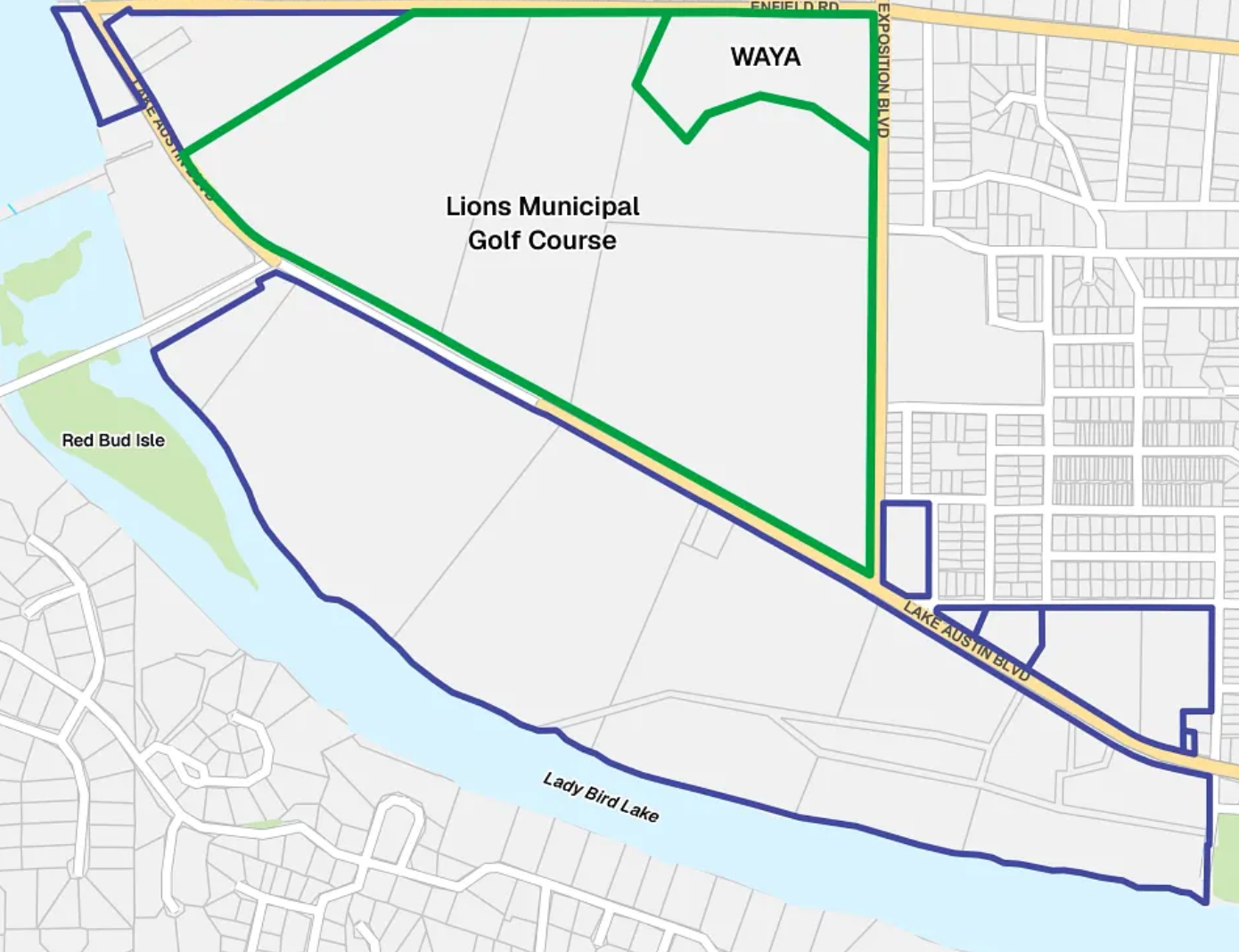
It sounds like UT is interested in exploring development on the other side of Lake Austin Blvd. This will apparently require an update to a 37-year-old agreement with the city and the city will have to rezone the property. Here's what Watson says:
After we update the BDA, we’ll need to approve a regulating plan, which is essentially zoning for the area, and we’ll need to create a Tax Increment Reinvestment Zone to pay for infrastructure.
OK. So maybe that will be good.
If you were forwarded this email, please consider getting your own subscription to the Austin Politics Newsletter!