What does the new ICE policy mean?
Betrayal or smart politics?


Greg Abbott threatened to claw back $2.5 million of state public safety grants unless the city of Austin agreed to change its policy on cooperation with ICE. Following negotiations between his staff and city staff, both sides announced they'd reached an agreement.
According to some on City Council, the city caved. According to others, the city stood strong. Who's right?
This week's sponsor:

Do you live in a condo regime that is frustrating you? I have helped developers create over 3,000 condo regimes and help owners modify cumbersome or outdated condo documents to save on insurance costs, eliminate monthly dues and make the condo function in a way that better fits the use. Contact Julie Alexander at Texas Condo Law to get started.
There is no way around it: APD changed its general orders.
The previous version said that officers "may" contact ICE if they discover that a person in their custody is subject to a non-criminal administrative warrant issued by an immigration judge. Now the orders state that officers "should, when operationally feasible," contact ICE.
A "person in custody" could simply be someone pulled over for a traffic infraction. It's not necessarily someone charged with a crime. In cases where the person has been charged with a separate crime, they would be arrested and taken to jail.
The general orders state the department will "generally" only make one attempt to contact ICE and that "officers shall not unreasonably prolong a lawful detention to contact ICE."
If ICE answers the call and requests that the person be detained, the officer will continue to detain the person if ICE can respond within an "reasonable amount of time." An APD Watch Lieutenant has the discretion to decide whether the amount of time requested by ICE is reasonable and could lead to other unfavorable outcomes, such or hindering criminal investigations and prosecutions (e.g. because the person is a witness or victim of a crime) or causing APD to "incur unreasonable overtime costs."
The policy still prohibits officers from arresting someone solely based on an administrative warrant or reporting someone to ICE who is not already in APD custody.
In his statements on social media and in his newsletter, the mayor did not explain any of the details of the new policy but simply said that the city and state had come to an agreement that allows the department to be practical and "will not create undue harm for residents who are the subject of noncriminal, administrative warrants."
Watson made sure to direct a few barbs at the governor, who he accused of threatening to "defund" a variety of key public safety programs.
"It's hard to wrap your head around the illogical notion that Austin should be punished for using pragmatic public safety practices to keep Texans safe, and the punishment is to defund public safety programs intended to keep Texans safe," he wrote.
Well said, mayor.
Watson is walking a delicate line here. He doesn't want to prolong the fight or bait Abbott into pushing further, but he has to make clear to the public that he is not happy about it and feels he didn't have a choice. He may also hope that casting Abbott's demands as a threat to policing and public safety will get the attention of people in the community who have Abbott's ear — perhaps some of the wealthy Republicans on the board of the Central Texas Public Safety Commission.
The fear is not just the loss of a $2.5 million of grants (although every dime counts these days at City Hall). City management is worried that engaging this battle could lead to even greater funding risks, particularly transportation funding.
Vanessa Fuentes, Zo Qadri, Mike Siegel and Jose Velasquez put out a statement criticizing the policy change:
When Governor Abbott threatened to strongarm Austin by gutting our victim services and defunding programs for our at-risk youth, the City had a chance to show every Austinite that their government answers to them, not to political threats.
That’s not what happened.
Although the City held firm on some core principles, City management capitulated to the Governor’s unreasonable demand to change our general orders and tamper with APD officers’ lawful discretion to choose not to call ICE when they encounter a non-judicial administrative ICE warrant.
The statement concluded: "Austinites deserve leaders who have their backs, unconditionally. We will explore all options in the coming days to reverse this disheartening decision.”
The most notable applause came from Chito Vela, who described the new policy as "substantially similar" to the prior one:
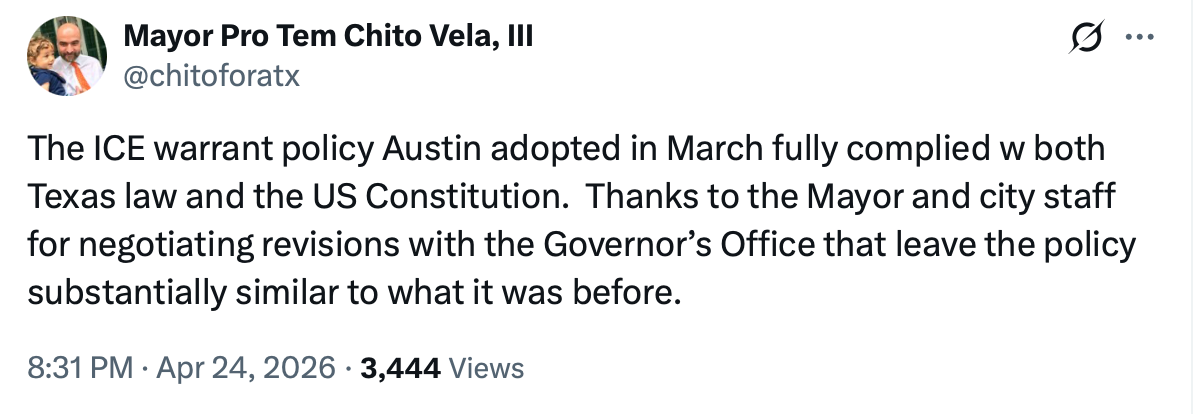
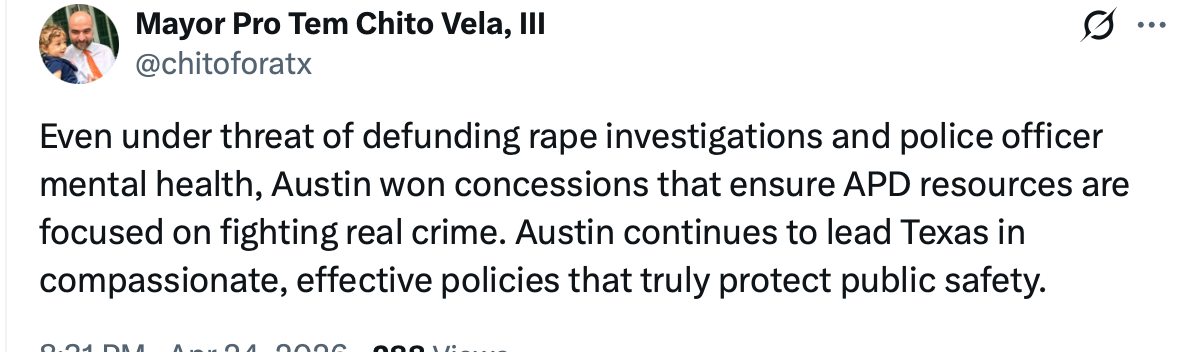
This will be the latest instance of Vela, a criminal defense and immigration attorney, clashing with his erstwhile supporters in the criminal justice reform movement. He also pissed them off royally over the police contract.
The four who denounced the policy change probably lack the six votes needed to pass anything at Council. That seems unlikely. Paige Ellis told me that she aligns with Vela's view. Ryan Alter declined to comment.
The policy change is pretty clear. What is not clear is how it will change the behavior of APD officers. One would imagine that this would have a lot to do with the direction from the Chief.
Please tell your friends to get their OWN subscription to the Austin Politics Newsletter! And if you found this article particularly valuable, you can show your appreciation by buying me a cup of coffee to fuel further investigation and analysis of city politics.