What's Watson's spending goal?
Does the mayor really want to shrink city government?

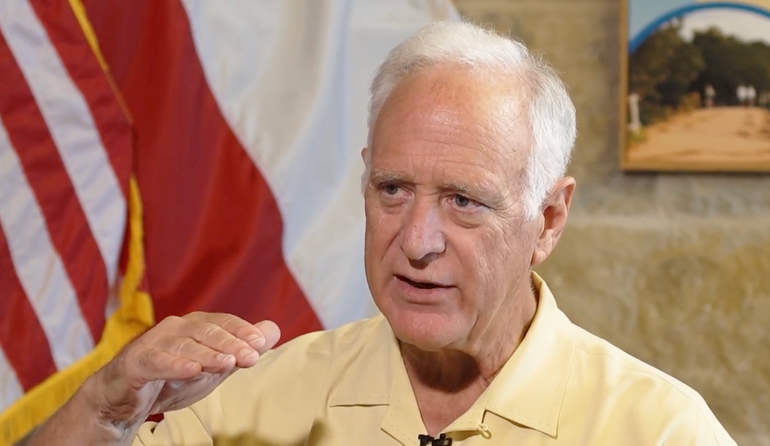
Mayor Kirk Watson sat down with KXAN's Grace Reader last week to dish on the recently-approved city budget, which he opposed along with only one other Council member.
The mayor's criticism of his colleagues was unusually direct. I found some of it fair and some of it misleading. But above all else I'm wondering what he hopes to accomplish with such an open confrontation.
Thanks to this week's sponsor!

Zoning, transit, infrastructure and development decisions can shape both a home’s value and your quality of life. Lonny Stern combines more than 20 years as an Austin Realtor with a professional background in urban planning, transportation and economic development. He currently serves on Austin’s Zoning & Platting Commission and helps clients make better-informed decisions about the property—and the city—around them.
Find a home that connects you to more of Austin.
City service is noted for biographical purposes only; no City endorsement is stated or implied.
Fair point on debt
Let's start out with something I agree with Watson on. He noted his opposition to the $295 million parks bond Council put on the ballot. He also highlighted his vote against the $36 million of additional debt Council authorized for transportation improvements.
I don't understand the point of having bond elections for some types of infrastructure but not others. Why is Council putting a parks bond on the ballot but issuing the debt for sidewalks and bike infrastructure without voter approval? That makes no sense and feeds cynicism about local governance.
Taxes
Watson, explaining his recent vote against the budget, noted that he had called for the city manager to present City Council with budget projections based on different tax scenarios, including a scenario where the city didn't increase its revenue at all.
"I called for, asked for and wanted us to have a No New Revenue forecast," he said. "I don't believe that ever received the kind of attention that it needed to have."
The city manager's staff did present such a forecast back in April. In the graphic below, the green line is the forecast assuming the city increases revenue by the maximum allowed without voter approval (3.5%) each year. The dark blue line reflects the No New Revenue rate.
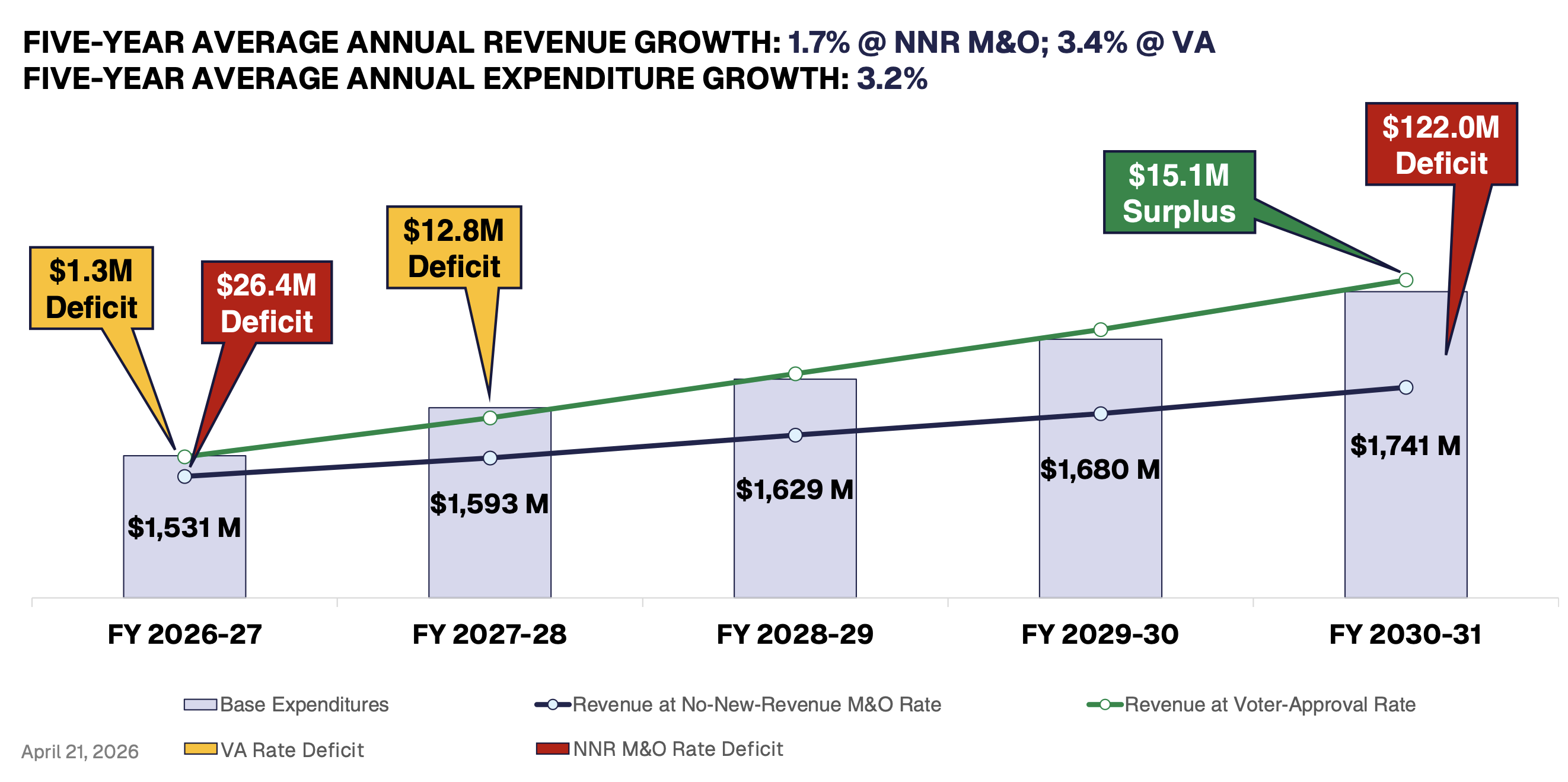
Without any increase in taxes, the city would have to immediately cut $26.4 million on top of the cuts the city manager had already made for the 3.5% budget. If Council chose to operate at the NNR level in subsequent years, the necessary cuts would grow even larger. It would have to cut $122 million in the FY 2031 budget.
The presentation offered some perspective on what it would take to achieve a $26 million cut. It is the equivalent of closing all community centers and pools. Or cutting 240 positions from police, fire and EMS.
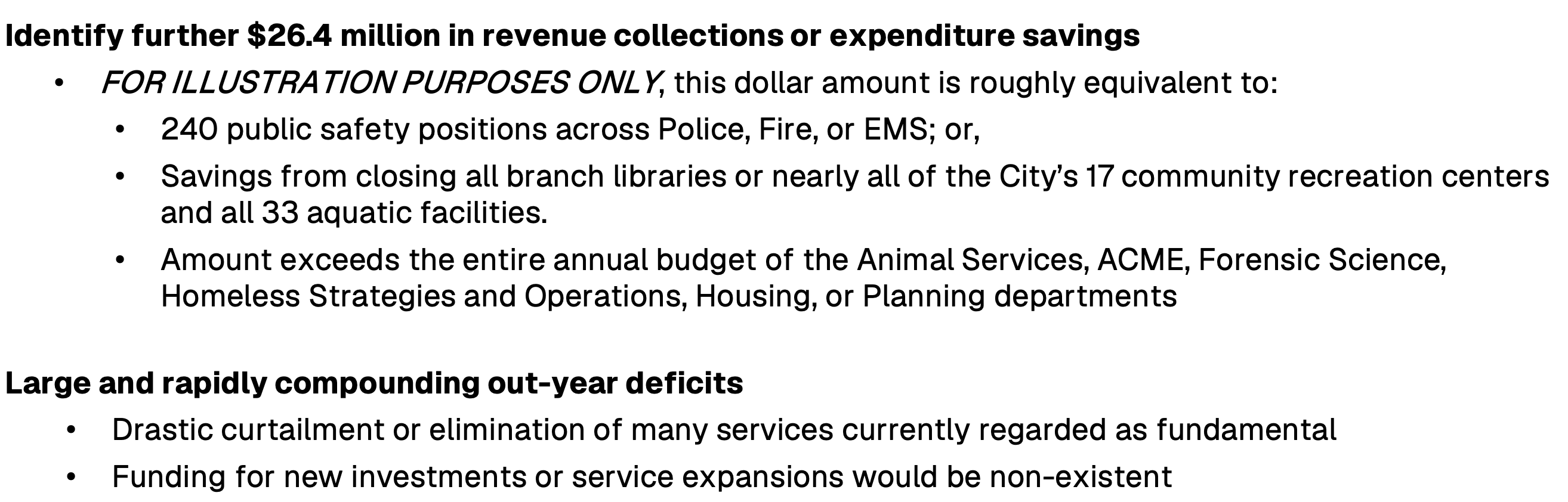
Perhaps Watson saw this presentation as not seriously engaging with the idea of a NNR budget. Maybe he really wanted every department (except APD, which CANNOT legally be cut) to submit a doomsday budget.
The reason staff didn't spend a ton of time crafting a NNR budget is likely because they recognized it was not remotely feasible and therefore not a good use of limited staff time. It's unrealistic not only because Council would balk at the $26M of cuts necessary this year, but because it would require the city to cut even deeper in future years.
The seductive idea that the city can simply forgo a spending increase this year clashes violently with the automatic spending increases that Watson himself has approved as mayor. I'm talking of course about the police, fire and EMS union contracts.
If you'll turn to page 40 of the budget, you'll see that simply funding the 5% pay increase the cops are due this year costs the city $11 million. And they're due another 5% next year, which will be more expensive because of the compounding effect. And then they're due a 4% raise the year after that.
The firefighters and medics, who did not get nearly as generous of a contract, are still owed $4.4 million and $2.2 million in pay raises this year. So that's $17.6 million of pay hikes this year the city can't get out of. The figure will be even greater next year.
With those cost drivers, adopting a budget with a 0% revenue increase creates a fiscal hole that is going to be very hard to climb out of.
If Watson wanted Council to have a serious conversation about a NNR budget, then he should have presented a serious NNR proposal himself. What would he cut?
What's strange is that not only did Watson support creating the spending obligations that are now weighing down the budget, but last year he nominally supported a budget that raised taxes well above the 3.5% level, otherwise known as Prop Q.
The rejection of Prop Q, combined with the revenue limits the state legislature adopted in 2019, has forced the city to make cuts. The city is now being forced to live within a the 3.5% per-year framework after generations of being allowed to go up to 8% each year without voter approval.
How much more does Watson really expect the city to cut? I think that he – and the city manager – believe that some of the $50 million in social service contracts the city is funding are not worthwhile, but does he really want to simply give that relatively small amount of money back to the taxpayers instead of putting it towards what he believes are more effective ones? After all, when $4.7 million of extra property tax revenue showed up right before the budget, he didn't propose giving it back to the taxpayers, but to restore service contracts focused on children.
Similarly, does Watson have reason to believe the city can actually reduce its homeless spending while reducing homelessness? Or should the public just suck it up and accept the situation isn't going to meaningfully improve? Similarly, are there other services the public should simply accept the gradual erosion of? Parks, libraries?
I get that Watson wasn't committing to a NNR budget. But he's saying that it should have been on the table and that the city should have gotten to a spending level below the max 3.5% rate. He has argued, in so many words, that the budget is irresponsible and disrespectful to taxpayers.
But if he actually envisions a future where the city is regularly adopting budgets below the 3.5% level, then he owes it to the public to lay out a longterm vision for a reduction in the size and scope of city government.
Feel free to occasionally forward along a newsletter to your friends, but please encourage them to get their own subscription! And if you found this article particularly valuable, you can show your appreciation by buying me a cup of coffee to fuel further investigation and analysis of city politics.