A look at the Council elections
Three races are heading to runoffs.

What do the results of the City Council elections tell us about the direction of the city and its voters?
The only thing apparent to me is that a lot of voters knew absolutely nothing about the candidates they cast ballots for. This is not unusual. It has been this way since at least 2014, when the city of Austin (following a 2012 charter election) aligned its elections with those of federal offices. You can argue about whether the city is better off when its public servants are picked by the small group of white geriatrics who show up for spring elections or by the clueless masses who show up for federal elections. I'm just giving you the facts.
Today's sponsor:
I lost my Council seat in 2024. I kept the habit of reading all the staff memos. From Mackenzie covers City Hall, the Capitol, Austin history, and whatever else I can’t stop thinking about. Free, sourced, and occasionally funny.
The fact is that when I spoke to two dozen people exiting the polls at the South Austin Rec Center on Tuesday, most either couldn't recall if there had been a City Council race on their ballot or tell me the name of the candidate they'd voted for. And this has been the case in every election I've covered.
This will not be the case for the three runoff elections for City Council on Dec. 12. It will be a much smaller electorate composed entirely of people who have an opinion about the City Council race.
Now let's take a look at the Council races. You can look more closely at the figures yourself on the Travis County results page.
District 1
In East Austin's District 1, Amber Goodwin and Misael Ramos advance to a runoff after basically tying at 34% a piece. Goodwin got 73 more votes (10,170) than Ramos.
The blue precincts below are ones where Goodwin finished in first; those in orange were carried by Ramos. They were the top two in every precinct.
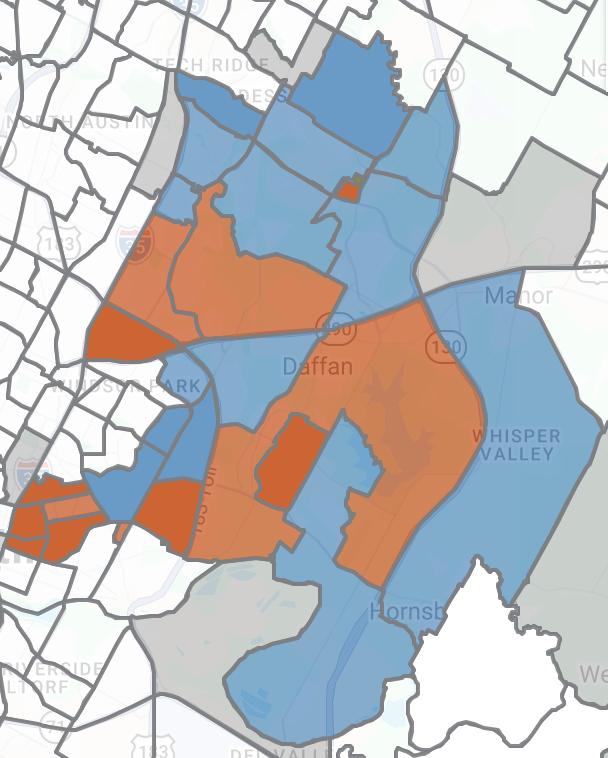
I'd be wary of drawing big conclusions from this map. It's just very hard to extrapolate from general election results to a runoff because the electorate is so different. Plus, in this race both top candidates were relatively competitive in every precinct.
For instance, in Ramos's home precinct, which includes the Blackland neighborhood, he got 44% to Goodwin's 31%. How many of those votes came from the highly-engaged types who know Ramos through his involvement in neighborhood advocacy and are very likely to show up in a runoff? And how many were just young people who don't even know what a runoff is? No idea!
Again, consider the 2018 election in D1. Mariana Salazar finished in first place with 26% to Natasha Harper-Madison's 25%. But none of Salazar's voters showed up in the runoff — NHM trounced her 72-28.
District 3
In District 3 Jose Velasquez came in first in every precinct but only finished with 47%, forcing him into a runoff with Neha Shah, who got 25%. Eduardo Romero, who raised about $1,000 overall and $0 from people not named Romero, got a respectable 12%.