
Efficiency? Or efficiency theater?
Bad data, questionable solution.


City Manager T.C. Broadnax feels he has a mandate for efficiency. And that feeling is certainly warranted. The city has a serious structural deficit and the voters have made clear they're not willing to solve it with higher taxes.
Hence his proposed consolidation of city IT services that has drawn howls of protest from AFSCME, the city employees union.
Thanks to this week's sponsor:

Adam Loewy is one of the top injury lawyers in Austin and very active in Texas politics. While he often disagrees with Jack Craver’s opinions, he’s proud to support independent media.
The justification for housing all of the city's IT workers in one department — Austin Technology Services — is a report last year by consulting firm Gartner that finds that the city of Austin spends 81% more on IT than "peer" cities. This stat has been uncritically reported in every news article I've read on the matter.
The problem, as is often the case with comparisons between Austin and other cities, is that many of the other municipalities cited don't operate massive utilities.
It's an important distinction that I fully expect the rubes on Twitter to neglect. But it's a distinction that anyone covering City Hall for a living (OK, maybe not quite a living...) should be sensitive to.
The Gartner report didn't neglect it. It did something worse: it acknowledged the distinction and misled readers into believing that it sought out fitting comparisons when it clearly did not.
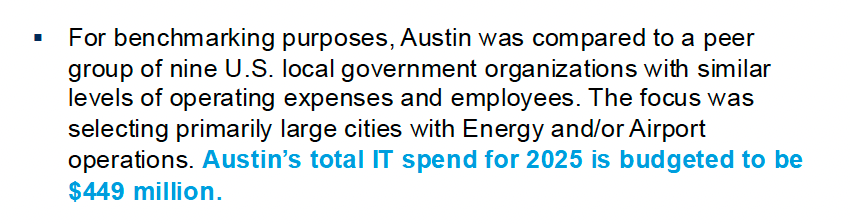
Here, in the beginning of the report (pg 9), Gartner says that the comparison group is made up of "primarily large cities with Energy and/or Airport operations."
On page 77, however, we discover that eight of the nine do not operate electric utilities and five of the nine don't operate airports.
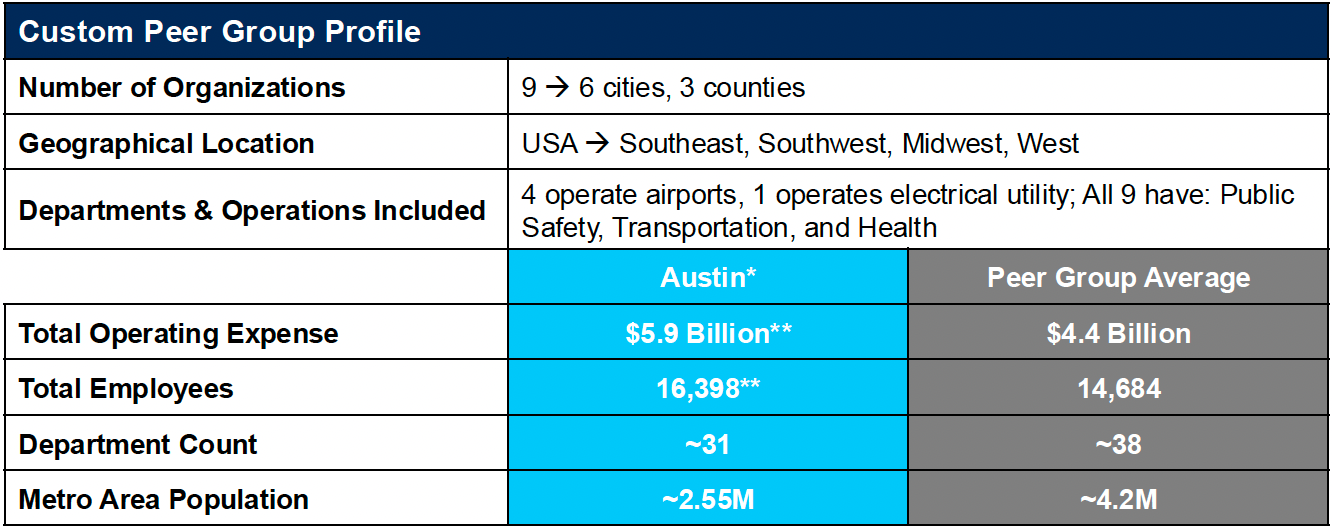
This is NOT a small detail! Austin Energy accounts for 29% of the city's budget and the airport accounts for another 7%.
The Gartner report does not address whether the peer governments operate their own water utilities and trash collection, which account for another 15% of Austin's budget.
To Gartner's credit, it conceded that the departments with the most IT spending were the ones most opposed to centralization. See below:
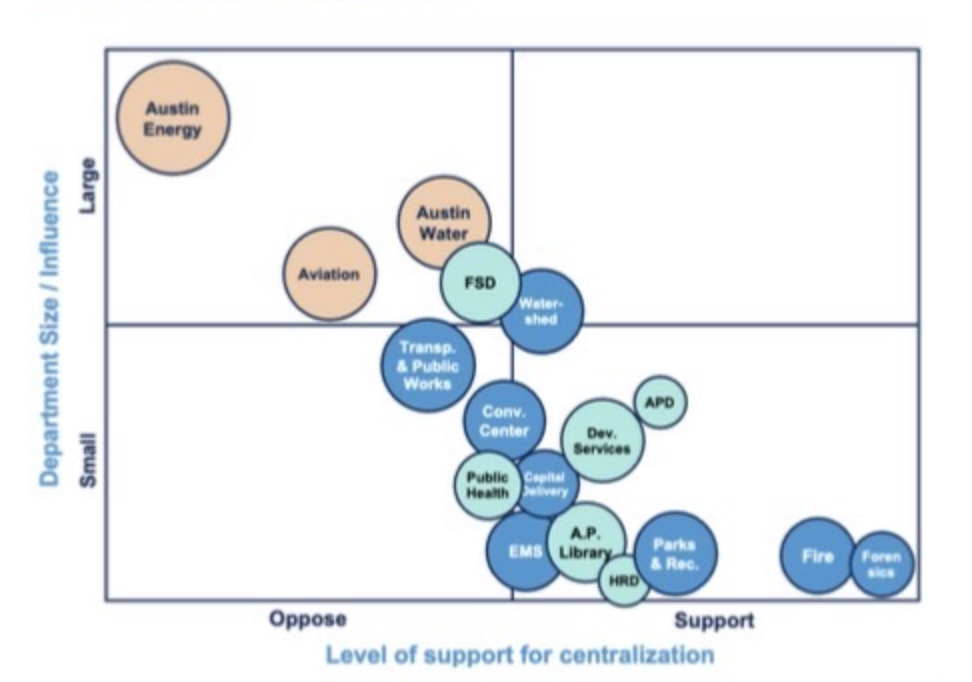
Austin Energy has absolutely no interest in having its IT workers overseen by people who know nothing about electric utilities. In a September memo to Broadnax that was shared with me, AE General Manager Stuart Reilly said the proposed centralization "introduces great risk" to the utility's service delivery.
"While AE supports citywide IT collaboration and efficiency, centralizing utility-specific technology functions poses serious risks to grid reliability, cybersecurity, regulatory compliance, and operational effectiveness," Reilly wrote.
The heads of three other major enterprise departments — Austin Water, Transportation & Public Works, Watershed Protection — wrote memos that were not nearly as critical but highlighted challenges of integration. Among other things, these agencies have distinct funding streams. They are funded by user fees, not general tax revenue. Those fees by law can only cover the "cost of service."
When I asked the city manager's office for a response to the critique, they responded with an April 1 memo attributed to "Department Directors" that said that positions tied to "operational technology" will remain with their departments.
"We understand and know that some teams manage complex equipment
where even a small delay in support can have major stakeholder impacts," said the memo.
But the distinction between OT positions and other IT positions remains ill-defined. Here's part of what AFSCME wrote in response to the memo:
There is no clear definition of OT, so the number of IT workers this change impacts is unknown. Recent analysis provided to us suggests it may be 5-10% or less of the 1,000 total IT workers impacted, depending on how Manager Broadnax defines OT. The City's own departments have already warned that technology roles cannot be neatly separated, and the City Manager’s team is learning in real-time how impossible it will be to peel apart OT and IT.
AFSCME has met with 10 of the 11 members of Council. There is only one member who has made clear he is 100% in the city manager's corner and has declined to meet with the union: Mayor Kirk Watson.
The consolidation is supposedly moving forward in May in the absence of intervention by City Council. A number of Council members are interested in acting. We'll see what happens.
The mayor, I am told, just wants cost savings and isn't interested in entertaining anything that might complicate that. And while Broadnax has publicly said that his goal is not to eliminate jobs, that is pretty obviously the goal if they're justifying this move with "data" suggesting that Austin spends way more on IT than necessary.
If there are redundant IT positions, then by all means they should be eliminated. But much like all of the focus on Council office spending this smells more like efficiency theater than a thoughtful effort to make government leaner and productive.
I understand the desperation to find cost-savings in the general fund ahead of the budget process, but it doesn't make sense at all to drag the enterprise departments, particularly Austin Energy, kicking and screaming into this process.
Eliminating IT positions at Austin Energy or the airport does not save you a dime in the general fund and therefore does not free up any money to prevent cuts to parks, social services, public safety etc. However, it does raise the risk of causing operational or security problems at the agencies where you least want operational or security problems! You don't have to have an especially long memory of Austin government to appreciate the danger of screwing up the utilities.
High risk, low reward. What are they thinking?
Please tell your friends to get their OWN subscription to the Austin Politics Newsletter! And if you found this article particularly valuable, you can show your appreciation by buying me a cup of coffee to fuel further investigation and analysis of city politics.