Muny is saved. What about the Brackenridge Tract?
Mayor Kirk Watson's deal is getting hit from both sides.

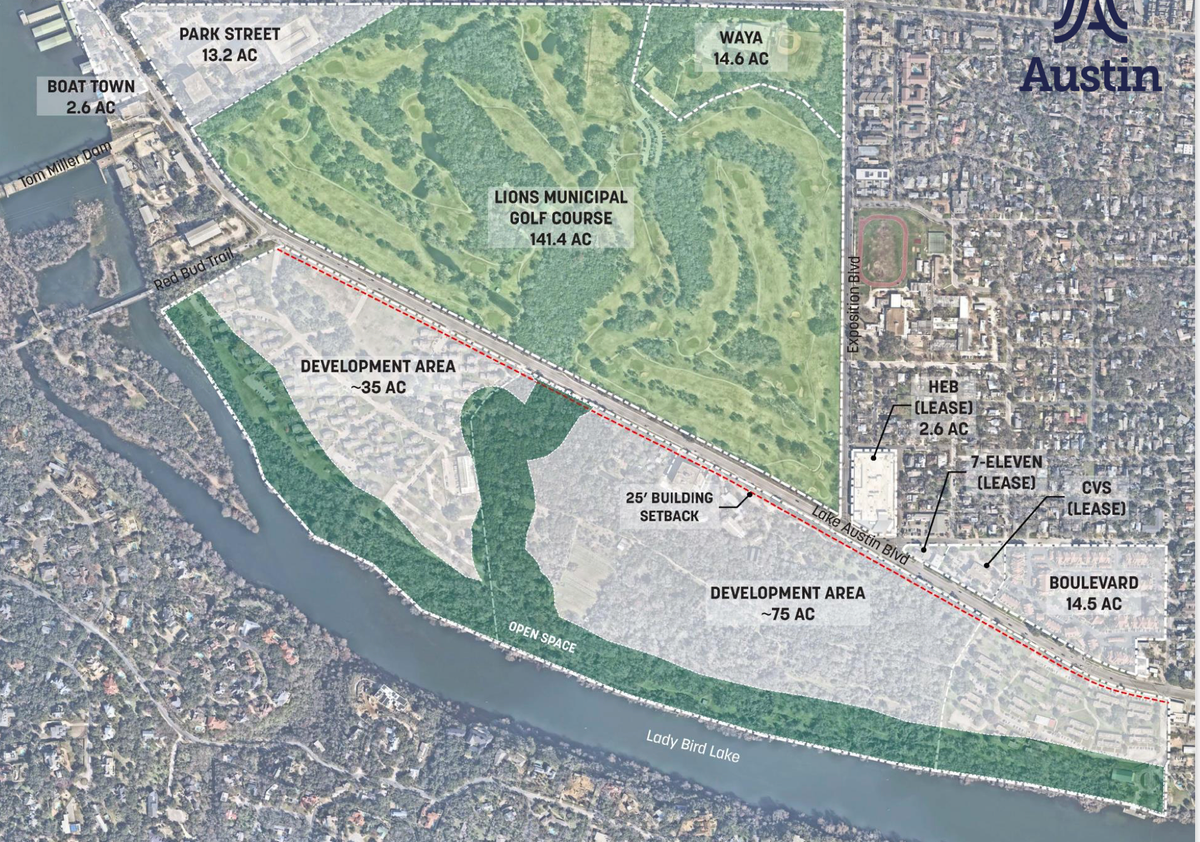
The deal that Mayor Kirk Watson struck with UT over the future of Lions Municipal Golf Course and the rest of the Brackenridge Tract along Lady Bird Lake is getting hit from both sides.
One side is happy to see Muny preserved but also doesn't want dense development to occur on the remaining 190 acres of the tract. The other side has a range of feelings about Muny but believes that if the golf course is preserved, the rest of the tract must be developed far more densely than the mayor's deal proposes.
Today's sponsor:

I lost my Council seat in 2024. I kept the habit of reading all the staff memos. From Mackenzie covers City Hall, the Capitol, Austin history, and whatever else I can’t stop thinking about. Free, sourced, and occasionally funny.
As a result, Watson has proposed delaying action on the deal, which Council is scheduled to take up on Thursday. In a post on the Council message board, he suggested postponing action until Dec. 3.
Last week's meeting of the Planning Commission offered a good display of two contrasting views on the future of the tract.
Just like at the Dog's Head hearing, local musician and Save Our Springs vet Bill Oliver came equipped with a song deploring the prospect of developing what he for some reason referred to as "Breck" (with an "e").
"Save Breck, Save Breck, oh please save the Breck Tract for me, for me," he sang to the tune of My Bonnie.
The SOS crowd opposing development is hardly notable. What is notable is the interest is the fierce opposition from scientific researchers who work at the Brackenridge Field Lab, which accounts for 82 of the 190 acres being rezoned and includes nine greenhouses and an 18,000 sq ft laboratory. It's home to 700 species of plants, 1,200 kinds of moths and butterflies and 160 bird species, Liz Bowman, a research scientist at the lab, told the commission.
In a letter to the mayor and city manager, Conner Philson, who runs the University of California Santa Barbara Natural Reserve System and is president of the Organization of Biological Field Stations, urged the city to protect the BFL's existing footprint as well as its "buffers" from development.
"Allowing development on BFL would permanently degrade its unique habitats, forfeit Austin’s only formal urban ecology research site, and end a public science and education resource that thousands of Austinites rely on," he wrote. "Field stations like BFL take decades to build and cannot be relocated or recreated once their ecological integrity is broken."
To be clear, nothing the city does dictates BFL's destiny. UT still owns the property and can hold on to it for as long as it wants. The fear is that rezoning the land to allow for much more intense development will incentivize the university to sell the property off.
The mostly urbanist membership of the Planning Commission is sympathetic to the plight of the BFL. Most of these people are environmentalists, after all. They don't see much ecological value in a golf course (quite the contrary) but they respect scientific research.
But their preferred method of preserving the lab is to allow much more intense development on the rest of the tract. The panel recommended limiting development entitlements on the BFL portion of the land but increasing them on the rest. Specifically, it unanimously recommended scrapping the proposed height limits outlined in the Watson deal.
Tax Increment Financing & affordable housing
Watson has proposed setting up a Tax Increment Reinvestment Zone to finance infrastructure on the tract. The way TIRZ works is that a certain portion (from 1%-100%) of the new tax revenue resulting from development in an area is devoted to paying off the debt issued to build the infrastructure.
In theory TIRZ is only supposed to be used to combat "blight" and nobody can argue with a straight face that this area is blighted. So it won't be surprising to see SOS, Bill Aleshire sue to block a TIRZ here.
The city's existing TIRZ policy requires 20% of new housing to be priced affordably for those at or below 60% of the area median income. However, the Watson deal would exclude this TIRZ from the requirement that the affordable housing be on-site.
The Planning Commission unanimously recommended that the required affordable housing be built either within the boundaries of the TIRZ or "within a reasonable buffer" of the TIRZ.
What's interesting here is that many on the Planning Commission are typically friendly to more flexible arrangements for affordable housing and are wary of imposing on-site requirements that may disincentive construction in areas where they want to see dense development (e.g. transit corridors). But some are annoyed, if not offended, by what appears to be an exception crafted on behalf of wealthy West Austin homeowners.
The other irony is to see urbanists, who typically complain that city development processes move way too slow, call on the city to slow way the hell down. The Planning Commission voted overwhelmingly (one against, two abstaining) to recommend that Council not take action on the deal until June 2027.
If you have a friend or colleague who regularly forwards you the newsletter, I strongly urge you to get your own subscription! I cannot do this work for free! And if you subscribe I will send you a personal email overflowing with gratitude.