"No one gives a shit about housing"
Guess who said it?

The title quote comes courtesy of our great leader, who is threatening to not sign a bill aimed at addressing the very real crisis of housing unless Congress also passes a bill to address the imaginary crisis of voter fraud.
Trump is unambiguously wrong, of course. Americans worry about the cost of housing far more than they worry about election integrity. That has always been true.
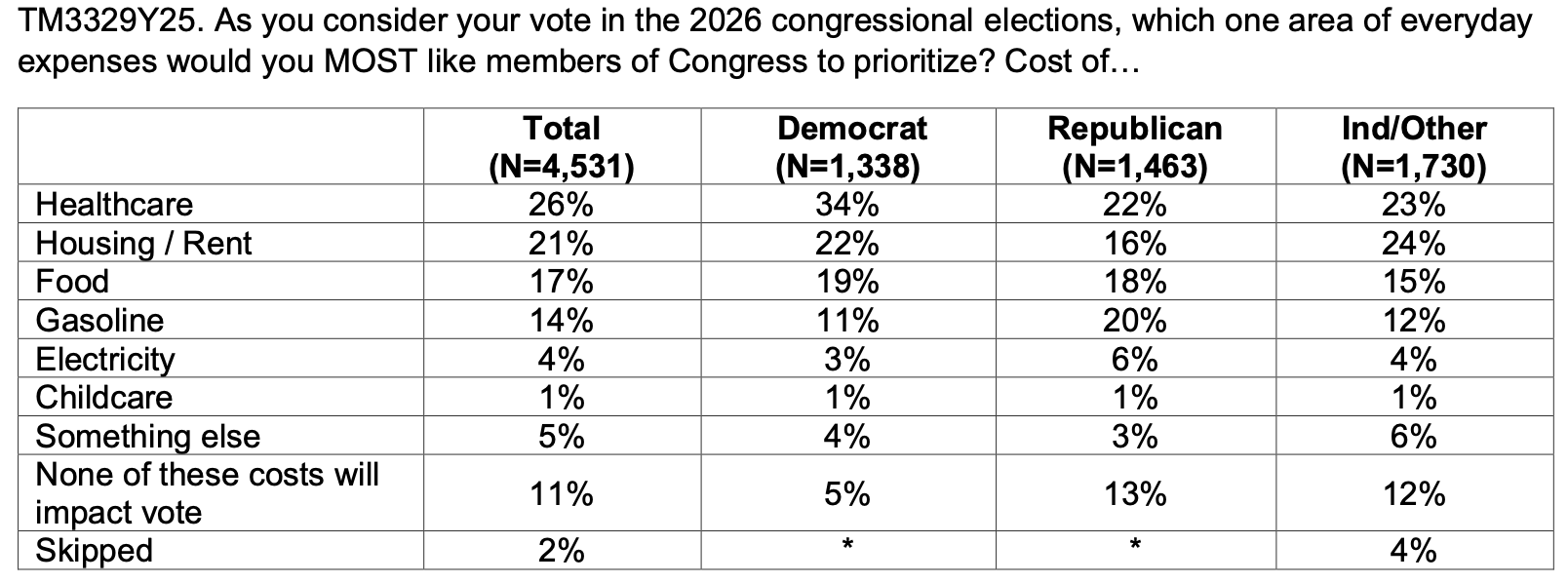
In a recent poll by Ipsos, housing was the second most-cited expense that voters wanted Congress to focus on bringing down. Among independents it was #1.
It's strange to realize, however, that until recently Trump's view appeared to be shared by most national politicians. In my quarter-century following U.S. politics, it's been rare to hear candidates for federal office talk much about housing, and especially not housing supply. It's by far the biggest cost in most people's lives but in political rhetoric it has always taken a backseat to health care, taxes and —particularly in recent years — higher education.
I think this helps explain why elected officials in blue cities like Austin were able to hold positions on housing for so long that were directly opposed to their professed support for the working and middle class. There was very little national discourse clarifying the "liberal" position on housing in the way that there was on myriad other issues.
I can't say that I've dug into the housing bill, but based on the surface-level coverage I've read it is mostly focused on regulatory reform. It doesn't override local zoning, of course, but it would allow HUD to favor communities with less restrictive housing barriers when awarding grants. It also exempts many federally-funded housing projects from the notoriously cumbersome NEPA environmental review.
Whether or not Trump signs the bill, it is the latest example of how YIMBYs have decisively won the national housing debate.
Of course the poor are the worst off
I have some compliments and critiques for this recent article in the Austin Current by Sam Stark about the state of the Austin housing market:
Years of zoning reforms and development incentives designed to encourage more housing construction have fueled growth, creating housing options attainable for some middle-income Austinites. A single person earning a little more than $55,000 a year, or a family of four making around $85,000, about 60% of the area’s median family income, should generally be able to find housing they can afford in the current market, according to housing experts.
However, housing officials say those gains break down for families earning below 50% of the median family income, or MFI, where the shortage of affordable housing units remains severe. Now, housing officials are exploring changes to Austin’s housing policies and incentives to better target the households they say the market has failed.
The main point of the article — that lots of people are still struggling to afford housing — is very important, especially for elected officials who might be tempted to believe that the housing issue has been "solved" by the softening of the rental market.
But I also think it's important to recognize that even those at the bottom of the rental market have benefited from reduced rents. You may still be housing-burdened (paying more than 30% of your income on housing), but you're still paying less than you would in a market with more constrained supply.
Some of the quotes in the article also reminded me of a certain type of comment that often comes up in Austin's housing discourse that is 100% accurate but still drives me crazy.
It's usually something like this: "The market is doing a good job of building housing for middle and upper-income people but is not doing good job of building housing for the lowest-income people."
In many cases it is expressed in even more technocratic terms: "The market is meeting the demand for households with incomes at or below 120% MFI as well as those between 60-120% MFI but is not producing adequate supply that is affordable to households below 50% MFI."
To which I say: NO SHIT!!
Market-rate developers do not build homes for the poor. That is not a problem that can be fixed. It is a reality that public policy must contend with.
One way to contend with it is through policies that make it easier to build new housing, which drives down the prices of the older housing that lower-income people are most likely to inhabit.
The other way to do it is through subsidized housing. The city does this through the housing bonds that voters have approved, although it appears unlikely that we'll see another housing bond until 2028.
Most of us who support maximizing the housing produced by the private sector are under no illusions that the market will deliver housing affordable to everyone. The goal is to let the market serve as many people as possible and then use subsidies to serve those with greater needs.
Please tell your friends to get their OWN subscription to the Austin Politics Newsletter! And if you found this article particularly valuable, you can show your appreciation by buying me a cup of coffee to fuel further investigation and analysis of city politics.