Which social services should be saved?
And why delaying a bond may not be fiscally responsible.

City Council got some good news last week: they're getting $4.7 million more in tax than expected after the Travis Central Appraisal District officially certified the property tax rolls. It is not uncommon for actual revenue to exceed the initial projections, but it is certainly welcome given that the proposed budget included $5.4 million in cuts to social service contracts. (You can examine the specific cuts here)
Cue the battle of the sub-quorums. Because of open meetings law (or at least the prevailing interpretation of the state's open meetings law), Council members split up into sub-quorums to discuss a given legislative issue. If they want to communicate with those outside of that group, they must do so publicly, such as on the Council message board.
So at 7 p.m. on Thursday came a statement from Mayor Kirk Watson calling for the funds to be used to restore social service contracts "with a focus on children." The statement was signed by the three others in his sub-quorum: Chito Vela, Krista Laine and Jose Velasquez.
At 7:05 pm another statement appeared from Vanessa Fuentes, proposing a budget amendment for the funds to be used to "restore social services," without any specification. She was joined by Zo Qadri, Natasha Harper-Madison, Paige Ellis and Mike Siegel.
Looking for an easy way to promote your business or nonprofit and support investigative journalism? Become an APN sponsor!
It's very possible these proposals aren't really in tension. It's not surprising to me that Watson, who tends to be more sensitive to right-leaning critiques of the city, would prefer to frame social service investments around children, who are harder to dismiss as lazy-good-for-nuthin-junkies.
And then today there was another update from Watson, who suggested that the manager's $5.4 million in cuts seemed to be applied arbitrarily:
First, there isn't a clear explanation for the decisions. “Strategic alignment” is listed as the reason to reduce 49 contracts and, at the same time, to leave 77 contracts carrying that same label untouched. The memo does not show how the review produced one result rather than the other. Council should be able to see that reasoning before it adopts the reductions.
Watson suggested the manager return with explanations for his proposed cuts.
Referencing the recent audit of social service contracts, Watson said the purportedly disappointing revelations should not be used to justify across the board social service cuts. The point of the audit, he said, is to improve the performance of social services, not to eliminate them.
This is not calling for a blanket restoration of every contract. Where the evidence supports a reduction, the City should make it. Where a contract needs to be improved, the City should improve it. Where the case for a cut to important services is not clear (services that we have previously determined we need and want), the City should maintain the service — and keep any real savings invested in better outcomes for children and youth.
The thing that really sticks with me is how little money this is. So much of the political debate at City Hall is about sums that are absolutely nothing in the context of city that is (sort of) home to a trillionaire.
It's important to note that even if the $4.7M nearly makes up for the $5.4 million in cuts in this budget, the city manager also envisions another $6-8 million in cuts next year unless new revenue emerges.
A smaller bond ≠ fiscal responsibility
Council will decide this week whether to put a bond on the ballot in November to fund parks, transportation and community facilities. The mayor has made clear that he wants to put off a bond until 2028, but there is a contingent on council that is particularly adamant about at least getting some parks funding on the ballot.
Here's what has been discussed for a potential bond:
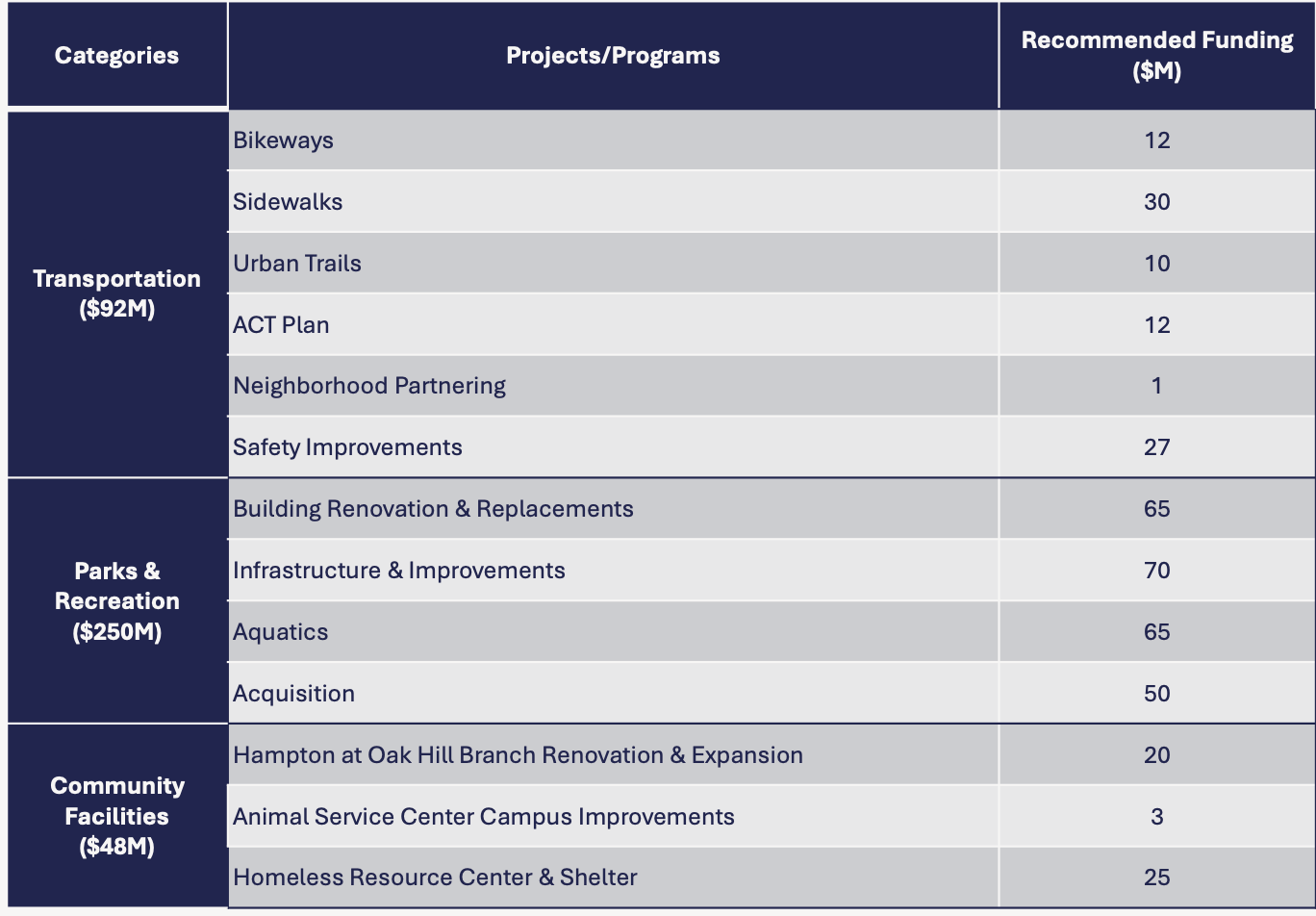
I'm hearing it's likely that Council will put a smaller measure on the ballot aimed at parks. What's funny is that in this scenario, the city may still end up funding the proposed transportation projects, but without voter approval. The city will simply issue certificates of obligation (debt) on its own for $80-90M of transportation projects.
In Texas local governments don't actually have to seek voter approval to debt-finance infrastructure. And yet, it's generally been the practice of the city of Austin to get an OK from voters for major investments.
The case for presenting a smaller bond package to voters will be that it's important to "send a message" about fiscal restraint. But if the transportation projects are going to be financed via COs anyway, then there is no benefit to taxpayers but a real cost to government transparency.
If a majority of Council wants to support transportation, they should put it on the bond with the rest of the spending. An additional $80-90M won't make the bond less likely to pass. That's not how voters think.
I expect those opposed to a transportation bond will point to the hundreds of millions of dollars that remain unspent from the 2016 transportation bond. But the highly effective sidewalk and bikeways programs shouldn't be punished for the comedy of errors plaguing the 2016 corridors program. The city has actually done a very good job of rapidly deploying funds for pedestrian and bike infrastructure in recent years and, in contrast to what a loud minority on social media suggest, those investments are generally popular. When I've asked people at the polls what they would like to see the city do on transportation, they most frequently say they want it to be easier to walk and bike. They never ask for wider highways.
Please tell your friends to get their OWN subscription to the Austin Politics Newsletter! And if you found this article particularly valuable, you can show your appreciation by buying me a cup of coffee to fuel further investigation and analysis of city politics.